Tonsil stones
The Reason Brushing or Diets Never Fixed it
Millions of people do everything right and still can't let anyone stand close to them. Here's what's actually happening — and why it has almost nothing to do with how clean your mouth is.
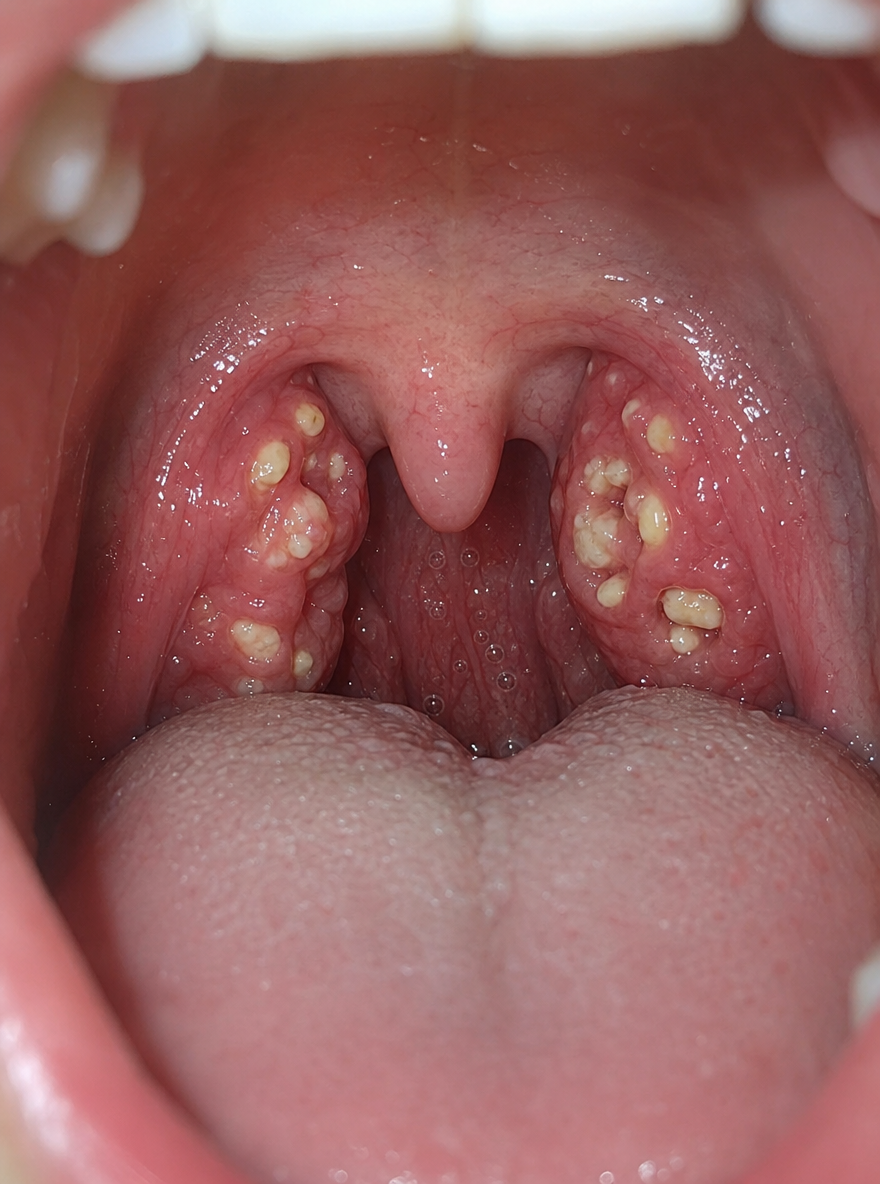
There's a version of this story that almost everyone who gets tonsil stones will recognise. The details change. The shape of it doesn't.
It starts with a small white lump coming up from the back of your throat. Hard, about the size of a grain of rice. You smell it once, and you spend the rest of your life recognising it.
That's the real cost. Not the stone — the awareness. Because now you can taste it at 9am in a meeting. On a first date. Mid-sentence with someone standing slightly too close. It sits at the back of your throat like a low hum you can never quite tune out, and every mint, rinse and tongue scrape buys you about forty minutes before it comes back.
You stop worrying about whether people can smell it. You start assuming they can
And once you know, you can't un-know it.
Nothing about your body changed that afternoon. But from that day the management starts, and it starts without you ever deciding to do it. Standing half a step further back than feels natural. Angling your head slightly when you speak. Sitting at the far end of tables. Turning over in bed rather than saying goodnight properly. Hugging people with one arm and a bit of daylight in between.
Then the buying. Two mouthwashes, one of them from the dentist. A tongue scraper. A water flosser. Breath strips in every bag and coat pocket. Gum, permanently. Brushing three times a day and flossing properly for the first time in your life.
And once you're looking, you notice everything.
The white coating on your tongue every single morning — the one you scrape until it feels raw, and it's back by the time you've finished getting dressed. The mucus sitting thick at the back of your throat that never quite clears, no matter how many times you swallow. The post-nasal drip you've stopped mentioning to people because there's nothing anyone can do about it. And that taste. Every swallow, a quiet reminder that it's still in there.
None of it changes. That's the part that quietly does the damage. Because if you're doing everything right and nothing improves, the only conclusion left is that there's something wrong with you.
There isn't. The reason it doesn't work is physical, and once you see it, the whole thing stops being about hygiene at all.
The problem is a few millimetres out of reach
Tonsils aren't smooth. They have deep folds in them, called crypts, and some people's are considerably deeper than others'. Debris settles down inside a crypt, hardens over time, and bacteria build up on it. That hardened lump is a tonsil stone, and the smell comes from the bacteria on it.
Which means the stone is forming inside a pocket, below the surface of your mouth. And that one fact explains every failed mouthwash you have ever bought.
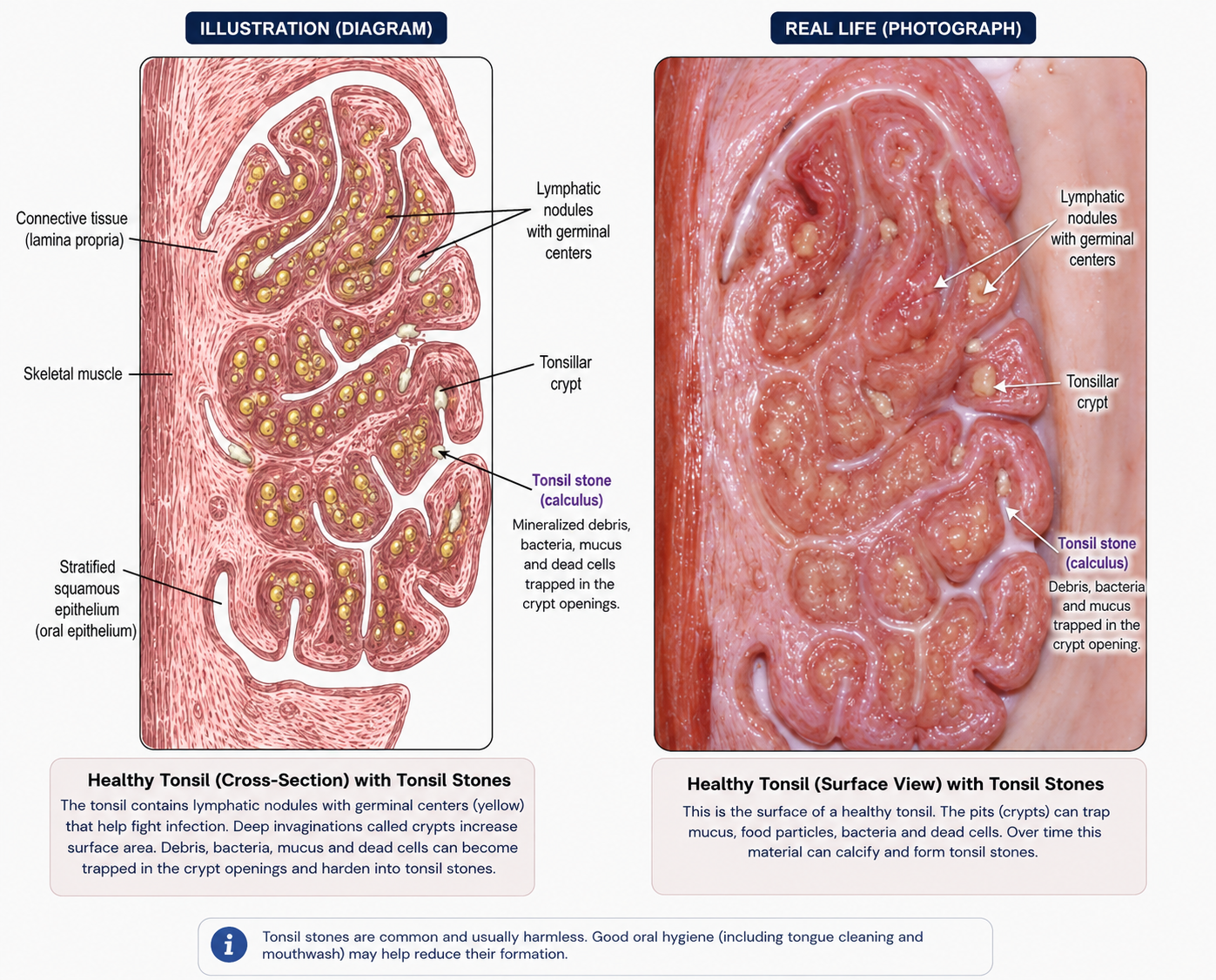
A toothbrush cleans teeth. Mouthwash rinses over the surface and past the opening of a crypt without going into it. Neither one was ever designed to reach a fold a few millimetres deep at the back of your throat, and neither one does.
So it was never a failure of effort. Your effort was going to the wrong place. That's the whole thing.
Why the usual answers don't work
Almost everyone works through the same list, in roughly the same order, over several years.
- Brushing more, tongue scraping Cleans teeth and tongue surface. Doesn't go near a tonsil crypt.
- Mouthwash, breath strips, gum Masks odour for twenty minutes or so. The source is untouched, so it returns on its own schedule.
- Salt water gargling Genuinely helps some people dislodge loose debris. Rarely clears a stone that has already hardened inside a crypt.
- Water flossers Water Flossers - Built for gums, not tonsils. Too little pressure and the stone moves deeper; too much and you can tear soft tonsil tissue. That damage heals as scar tissue, which distorts the crypts and gives future stones more places to sit.
- Cotton buds and improvised tools The most common approach, and the riskiest. You're working blind on soft tissue at the back of your own throat, with a gag reflex, in a bathroom mirror. Pushing a stone deeper is a frequent outcome.
And many people do eventually ask a dentist or GP, and are told — correctly — that tonsil stones are common and generally harmless. That's true medically. It's also not much use when the actual problem is that you've stopped letting people stand near you.
What it costs to have it dealt with for you
There is a permanent procedure. It's called laser cryptolysis, it resurfaces the crypts so debris has nowhere to collect, and privately in the UK it is typically priced like this:
Private laser cryptolysis
£950 – £1,200
Plus £250–£400 for the consultation, before anyone does anything, to find out whether you are a candidate at all.
Doing it at home, with a light
£59
The complete TonsiCare Pro system. Free shipping. 30-day money-back guarantee.
For most people the procedure is a straightforward no. Which leaves doing it yourself — and the only reason doing it yourself goes badly is that people attempt it blind.
What changes it is being able to see
This is the part that sounds too simple. Almost everyone who has tonsil stones has spent years trying to solve something they have never actually looked at. A bathroom mirror, a phone torch held in your own mouth, and a cotton bud is not looking at it. It's guessing.
TonsiCare Pro is a slim tool with an HD camera and an LED light built into the tip. It makes its own Wi-Fi signal, so you join it from your phone and watch your own tonsils on the screen — lit, magnified, with the crypts visible and whatever is sitting in them clearly in view.
Once you can see where they actually are, the job changes completely. You're not fishing around hoping to catch something. You go to a specific place, and you lift the stone out with one of the smooth stainless steel tips included in the kit.
Connect and look
Join the device's Wi-Fi from your phone, open the free app, and light up the back of your throat. Most people find stones on the first look that they had no idea were there.
Clear at the source
Fit a tip, and ease each stone out of the crypt while watching the screen. Because you can see, you're in and out in seconds rather than probing blindly for minutes.
Check, don't guess
Crypts refill over time in people prone to them. A quick look every couple of weeks means you catch them early, instead of finding out socially.
Worth being straight about two things. The first session is not a pleasant experience — you will see things you'd rather not know were in there. And it doesn't change the shape of your tonsils, so if you're someone who forms stones, you'll form them again. What changes is that you can now find and clear them yourself in a few minutes, instead of waiting for the next one to announce itself.
What actually comes back
The physical part is straightforward and it happens quickly. The other part takes longer, and nobody warns you about it, so it's worth setting out honestly.
- Tonight
The first look
Connect to your phone and light up the back of your throat. Most people clear several on the first session, including ones in folds they never knew existed. It takes about fifteen minutes and it is not a nice fifteen minutes — but it's the first time the problem stops being abstract.
- First fortnight
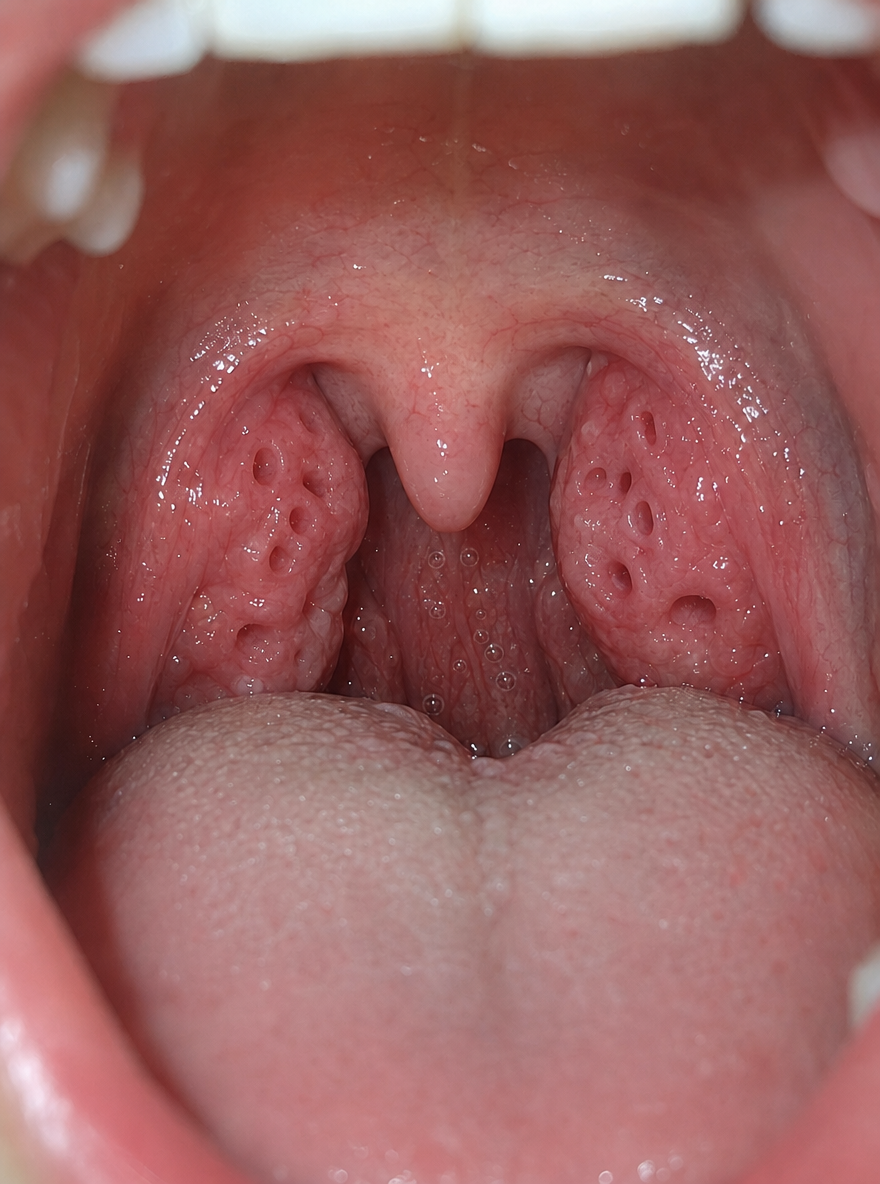
The backlog clears
Short sessions to work through what has accumulated, sometimes over years. The taste in your own mouth changes within a day or two — and most people don't realise it had been there constantly until the day it isn't.
- Ongoing
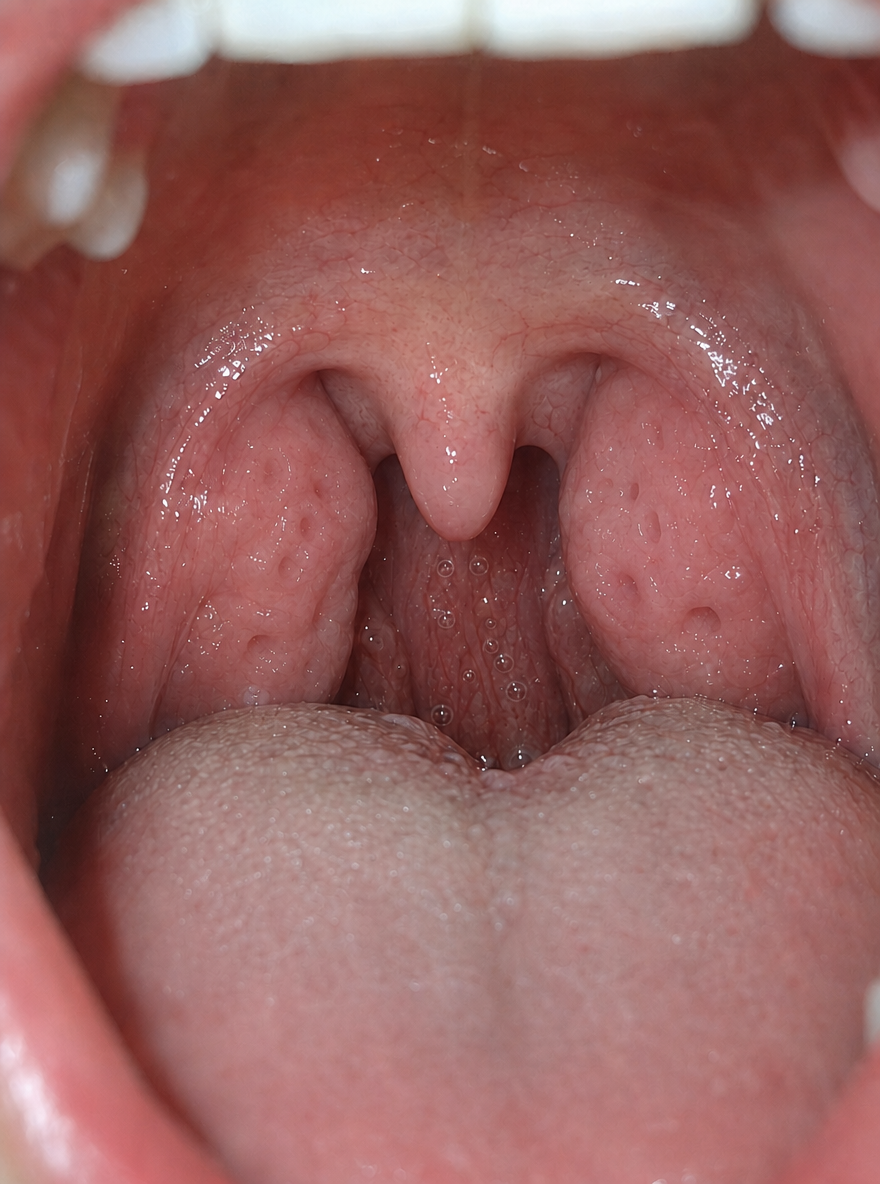
A couple of minutes, weekly
Crypts refill in people prone to them, so this doesn't end — but it does get small. A quick look with the light on catches them while they're still forming, rather than you finding out socially.
Illustrative photographs of what the crypts look like at each stage — not a customer before-and-after. Individual experience varies.
Then there's the part that lags, and nobody warns you about it. The half-step back, the hand over the mouth, the turning over in bed — those were built over years, and they don't switch off the week the stones do. They fade over a month or two, and you almost always notice them going backwards, after the fact.
And the noticing is almost always small and specific. It's swallowing halfway through a sentence and not bracing for what comes with it. It's the gym, three sets in, throat dry the way it always is — and the dryness tasting only of dryness. It's realising you can't remember the last time you cleared your throat, or checked the mirror before leaving a room, or did the maths on how close you were standing to someone. It's someone leaning in to say something quietly — and you not moving. And then, in the car afterwards, understanding that you spent the whole evening thinking about the evening, and nothing else.
Nobody sets out to buy a camera on a stick. What people are actually trying to get back is the ability to stand close to somebody without running a calculation first.
That's the part worth £59. The device is just how you get there.
The complete system, £59
Camera and LED tip, your phone as the screen, and a set of smooth stainless steel removal tips.
See what's includedFree shipping · 30-day money-back guarantee
The questions people actually ask
Why £59 when there are removers on Amazon for under a tenner?
Because those are picks and loops with no camera and no light. They're the same approach as a cotton bud, in metal. If you've owned one, you already know the problem: you can't see what you're doing, so you're working blind on soft tissue at the back of your own throat. The camera isn't a luxury feature bolted on to justify the price — it's the reason the thing works at all.
Won't I gag?
Possibly, especially the first time. It is noticeably better than improvising with a cotton bud, though, for one reason: you can see where you're going, so you're in and out in seconds instead of probing around for minutes. Most people find it gets easier by the second or third session. We're not going to claim it's enjoyable.
Is it safe to do this myself?
Be gentle, work slowly, and stop if anything hurts or bleeds — tonsil tissue is soft. The single biggest risk with at-home removal is doing it blind, which is exactly what this is designed to stop. If you have severe pain, difficulty swallowing, a fever, or bleeding that doesn't settle, that's a conversation with your GP rather than something to handle at home.
Will they come back?
If you're someone who forms them, yes — the crypts are still there, and the only thing that permanently changes that is a procedure. What changes is that you can find and clear them in a few minutes, on your own schedule, rather than discovering one mid-conversation.
Does it work with my phone?
It works with iPhone and Android. The device creates its own Wi-Fi signal — you join it in your phone's settings and open the free app, and the live feed appears. Setup takes about a minute the first time, roughly ten seconds after that. It's USB rechargeable, so there's nothing extra to buy.
How long does delivery take?
Free tracked shipping, 7–12 business days. We'd rather tell you that up front than promise next-day and disappoint you.
What happens if it doesn't work for me?
You have 30 days. Email us and you get your money back. You don't need to give a reason
Thirty days to decide
Nobody should be asked to pay for something in this category on faith.
- 30-day money-back guarantee.
- Free shipping on every order, tracked, 7–12 business days.
- A real UK brand with a contact address and a person who answers email.
Stop guessing at the back of your own throat
TonsiCare Pro — camera, light, and gentle stainless tips. £59 complete.
See the full kit and bundlesFree shipping · 30-day money-back guarantee
